
College Loan Forgiveness Guide: Step by Step Filing, Eligible Jobs, and Key Approval Tips

Student loan forgiveness can feel harder to understand than the loan itself. The rules depend on your loan type, repayment plan, work history, and the forgiveness program you use. A missed form or wrong repayment plan can delay approval for years.
This guide walks through the main federal forgiveness paths, how to file step by step, which jobs can help your odds, and what to check before you submit anything.
This article is for general information only. Student loan rules can change, and your best source for official program details is Federal Student Aid at StudentAid.gov or your loan servicer.

Start by knowing which forgiveness program fits your situation
Most student loan forgiveness programs are for federal student loans, not private loans. If your loans came from a private bank, credit union, or online lender, federal forgiveness programs usually will not apply. Private lenders may offer hardship options, but those are not the same as federal forgiveness.
The main federal forgiveness paths include:
Program | Best fit | What usually matters most |
Public Service Loan Forgiveness | Government and qualifying nonprofit workers | Eligible employer, Direct Loans, 120 qualifying payments |
Income-driven repayment forgiveness | Borrowers on income-based plans for many years | Repayment plan, payment count, loan type |
Teacher Loan Forgiveness | Certain teachers in low-income schools | Subject area, school eligibility, five years of service |
Perkins Loan cancellation | Certain public service jobs with old Perkins Loans | Job type and qualifying service |
Borrower Defense to Repayment | Borrowers misled by their school | School misconduct and supporting evidence |
Closed School Discharge | Borrowers whose school closed | Timing of closure and enrollment status |
Total and Permanent Disability Discharge | Borrowers who meet disability criteria | Documentation from approved sources |
For many borrowers, the strongest options are Public Service Loan Forgiveness, often called PSLF, and income-driven repayment forgiveness. PSLF is tied to qualifying work. Income-driven repayment forgiveness is tied to time in repayment under an eligible plan.
A good College Loan Forgiveness Guide starts with one question: What are you trying to qualify under, public service, long-term income-based repayment, teaching service, school misconduct, school closure, or disability discharge?
Step by step process for filing for loan forgiveness
The exact form depends on the program, but the filing process follows a similar path. Do these steps in order so you do not waste time on the wrong application.
1. Confirm that your loans are federal loans
Log in to your StudentAid.gov account and review your loan details. Look for your loan type, servicer, repayment plan, and loan status.
Common federal loan types include:
Direct Subsidized Loans
Direct Unsubsidized Loans
Direct PLUS Loans
Direct Consolidation Loans
Federal Family Education Loan Program loans, often called FFEL
Federal Perkins Loans
This matters because many newer forgiveness programs require Direct Loans. If you have FFEL or Perkins loans, you may need to consolidate into a Direct Consolidation Loan before some programs will count future payments.
Be careful here. Consolidation can help in some cases, but it can also affect payment counts, interest, and program eligibility. Check the current rules before you consolidate.
2. Identify the forgiveness program you want to use
Do not file every form you can find. Match your situation to the program first.
Use PSLF if you worked full-time for a qualifying employer while making eligible payments. Use Teacher Loan Forgiveness if you taught for five complete and consecutive academic years at an eligible low-income school or educational service agency. Use an income-driven repayment path if you are focused on monthly payment affordability and long-term forgiveness after the required repayment period.
If your school closed or misled you, look at discharge options rather than employment-based forgiveness.
3. Check your repayment plan
Your repayment plan can make or break eligibility.
For PSLF, qualifying payments are generally made under an income-driven repayment plan or another qualifying plan. For income-driven repayment forgiveness, you must be enrolled in an eligible income-driven repayment plan.
Income-driven plans calculate monthly payments using income and family size. They may also require annual recertification. If your income changes, update your information when required so your payment remains accurate.
If you have spent years on the wrong plan, do not assume the time is lost. Federal rules have changed more than once, and some adjustments have helped borrowers receive credit for certain past periods. Check your official payment count before making decisions.
4. Gather your employment records
For employment-based forgiveness, your job history matters as much as your loan history.
Create a simple record with:
Employer name
Employer address
Employment start and end dates
Full-time or part-time status
Average weekly hours
Job title
Employer Identification Number, often found on a W-2
Supervisor or HR contact information, if available
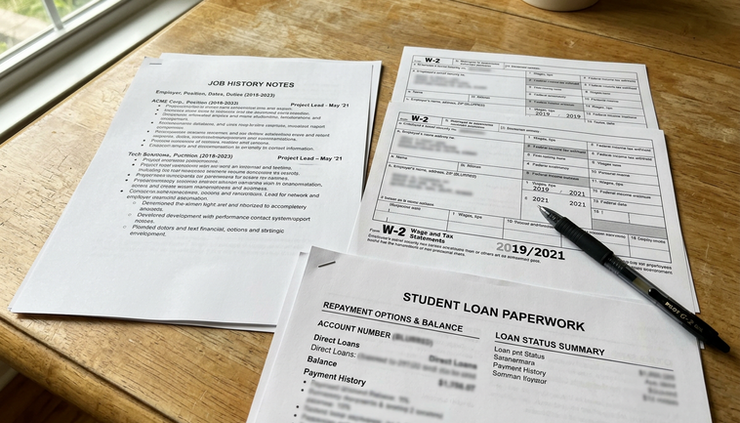
For past jobs, W-2 forms, pay stubs, contracts, personnel records, and written employer verification can help. If an employer closed or merged, keep any records that show the organization’s name, type, and your dates of service.
5. Use the official application or tool
For PSLF, use the official PSLF Help Tool through StudentAid.gov. It helps confirm whether your employer may qualify and guides you through the employment certification process.
For teacher forgiveness, use the official Teacher Loan Forgiveness application. Your school’s chief administrative officer usually must certify your teaching service.
For income-driven repayment, apply for or renew your plan through StudentAid.gov. Your servicer handles payment processing and account updates.
For discharge programs, use the official application tied to that discharge type. These forms often ask for specific documentation. Read the instructions before submitting.
6. Submit employer certification early and often
For PSLF, do not wait until you think you have 120 payments. Submit employment certification as you go, especially when you change jobs.
This helps you:
Confirm whether the employer qualifies
Build your qualifying payment count
Catch errors earlier
Avoid hunting down old HR contacts years later
A common mistake is assuming a job qualifies because the work “feels public service.” PSLF focuses mainly on the employer type, not your job title. A nurse at a nonprofit hospital may qualify. A nurse at a for-profit hospital usually does not qualify for PSLF based on that job.
7. Track your payment count
After you submit forms, check your account for updated counts. Do not rely only on memory or old emails.
Keep copies of:
Submitted applications
Confirmation emails
Employer certifications
Payment histories
Servicer messages
Annual income recertifications
If your count looks wrong, ask for a review. Payment counts can be affected by deferments, forbearance, consolidation, repayment plan changes, and servicer transfers.
8. Respond quickly to requests for more information
Forgiveness applications can stall if a signature is missing, an employer date is unclear, or a form has conflicting information. Read every notice from your servicer or Federal Student Aid account.
If you get a denial, do not panic. Many denials happen because the borrower used the wrong form, had the wrong loan type, lacked employer certification, or had not reached the required payment count yet.
A denial may mean “not yet” rather than “never.”
Jobs that can help approval odds
For employment-based forgiveness, “approval odds” improve when your work clearly fits the program rules and your records prove it.
Government jobs often qualify for PSLF
Work for federal, state, local, or tribal government agencies is commonly qualifying for PSLF if the other rules are met.
Examples include:
Public school employees
City, county, or state workers
Public health department employees
Military service members
Public defenders and prosecutors
Public library employees
Public university employees
Law enforcement and emergency services employees
Your title does not have to be flashy. Administrative, technical, maintenance, and support roles can count if the employer qualifies and you meet the work-hour rules.
Nonprofit jobs may qualify
Many 501(c)(3) nonprofit organizations qualify for PSLF. Some other nonprofits may qualify if they provide certain public services, but those cases can require closer review.
Examples may include:
Nonprofit hospitals
Charitable organizations
Some community health centers
Nonprofit colleges and universities
Legal aid organizations
Public interest groups
Certain social service organizations
Do not assume every nonprofit qualifies. Confirm the employer’s status using the PSLF Help Tool and official records.
Teaching jobs can help under more than one program
Teachers may have options under PSLF, Teacher Loan Forgiveness, or both, depending on the school, loan type, and service period.
Teacher Loan Forgiveness generally applies to certain teachers who complete five consecutive academic years at an eligible low-income school or educational service agency. Some math, science, and special education teachers may qualify for higher forgiveness amounts under that program than other eligible teachers.
PSLF can be broader because it may apply to many public school and nonprofit school employees, not only classroom teachers, if the employer and payment rules are met.
Health care and social service roles can be strong fits
Many public service health care roles can support PSLF when the employer is a government or qualifying nonprofit entity.
Examples include:
Nurses at nonprofit or public hospitals
Physicians at qualifying public or nonprofit facilities
Mental health counselors at eligible nonprofits
Case managers at social service agencies
Public health workers
Substance use counselors at qualifying organizations
The key is still the employer. A job that serves the public does not automatically qualify if the employer is for-profit.
Military and public safety roles may help
Military service, police, fire, emergency medical services, and corrections work may qualify under PSLF when tied to a government employer. Some service members may also receive special student loan benefits outside forgiveness, so it is worth checking official military and federal aid resources.
Past jobs can count if they met the rules
Previous jobs can help approval if they were qualifying jobs during months when you also made eligible payments. You do not need to still work for every past employer to document that time.
Past employment is often where borrowers leave money on the table. If you spent two years at a public university, three years at a nonprofit hospital, and then moved to another qualifying employer, all of that time may matter for PSLF if the payments and loan rules line up.
What to look for before you apply
Small details can decide whether your application moves smoothly or gets delayed.
Look for the right loan type
If a program requires Direct Loans, do not assume all federal loans qualify automatically. Check each loan. Older FFEL and Perkins loans may need special handling.
Look for qualifying payment months
A qualifying payment is not only a payment you made. It must meet the program rules for timing, amount, repayment plan, loan type, and employment period when required.
For PSLF, the standard target is 120 qualifying monthly payments. These payments do not need to be consecutive.
Look for employer type, not just job duties
This is one of the biggest PSLF misunderstandings. The employer’s legal status usually matters more than your daily tasks.
A janitor at a public school may qualify. A physician at a for-profit clinic may not. A software worker at a city agency may qualify. A social worker employed by a for-profit contractor may not, even if the contract supports a public program.
Look for signatures and matching dates
Many forms get delayed because dates do not match payroll records, signatures are missing, or the employer section is incomplete.
Before submitting, check:
Your name matches your StudentAid.gov account
Employer dates are accurate
Employer Identification Number is correct
Your signature and date are present
Employer signature and date are present, if required
The form is not altered in a way that makes it invalid
Look for tax effects
Some forgiven student loan debt may be excluded from federal income tax under current or temporary rules, while other forgiveness may have tax consequences in the future or at the state level. Tax treatment changes, so confirm current rules before relying on forgiveness as part of a long-term financial plan.
Common mistakes that delay forgiveness
The mistakes below are common, avoidable, and expensive in terms of time.
Waiting too long to certify employment
For PSLF, certify early. That way, you know whether your employer and payments are counting.
Assuming private loans qualify
Private student loans generally do not qualify for federal forgiveness. Refinancing federal loans with a private lender can cause you to lose access to federal forgiveness programs.
Ignoring income recertification
If you are on an income-driven plan, missing recertification can change your payment and create problems. Keep reminders in your calendar.
Using the wrong program
Teacher Loan Forgiveness, PSLF, and income-driven repayment forgiveness have different rules. The best program may not be the one with the shortest application.
Not keeping records
Servicers can change. Employers can close. Systems can update. Keep your own file.
A practical filing checklist
Use this checklist before you submit a forgiveness or discharge request:
Log in to StudentAid.gov and list every federal loan
Confirm which servicer handles each loan
Identify the forgiveness or discharge program
Check whether your loans are eligible
Confirm whether consolidation is needed or risky
Review your repayment plan
Create a job history with dates and employer details
Collect W-2s, pay stubs, and HR contacts for qualifying jobs
Use the official application or tool
Save copies of every form and message
Track your payment count after submission
Follow up if your account does not update
What success looks like
A strong forgiveness filing is clear, documented, and tied to the right program. You know your loan type. You know your repayment plan. You know which employers count. You have forms that match your records, and you keep proof of every submission.
The best next step is simple: log in to StudentAid.gov, list your loans, and match each one to the forgiveness path that fits your work history and repayment record. Once you know the program, the filing process becomes much easier to manage.


Comments